The upstream version of this idea, where the sewer lines and lift stations become the first stage of treatment, is on the AerobicShift page. What we hand you before the first dose, and how we set up a trial you can defend to a board, is on the testing and documentation page.
TECHNOLOGY / HOW IT WORKS
How DRP Accelerator Works: Oxygen for the Bacteria Already in Your System
DRP Accelerator is an inorganic compound that carries oxygen in a form the bacteria already living in your wastewater can use. We add no bacteria, no enzymes and no chemical additives. Where the water has run out of oxygen, in a sewer line, a wet well or a lagoon bottom, the native bacteria take the oxygen we bring instead of stripping it from sulfate. Hydrogen sulfide does not form, and the grease and settled solids that anaerobic conditions leave alone start to break down. We deliver it as a monthly service we run for you.
Your bacteria are starving for oxygen. We bring it to them.
- DRP Accelerator is an inorganic compound that carries oxygen in a form the bacteria already living in wastewater can use.
- Hydrogen sulfide forms in sewers and lagoons when bacteria take oxygen from sulfate after the water's dissolved oxygen is gone.
- When usable oxygen is available, native bacteria use it instead of sulfate, so the sulfide that becomes hydrogen sulfide is not made.
- The accelerator adds no bacteria and no enzymes; the bacteria already in the system do the work.
- Waste Water Innovations delivers the accelerator as a monthly service: a tank and a continuous drip at the dosing point, monitored remotely and replenished every four to eight weeks.
- In Waste Water Innovations' field work, reductions typically begin to show within six to eight weeks of the first dose.
- DRP Accelerator is made by DRP Seven; Waste Water Innovations is its exclusive distributor for the United States.
What happens in the water
The bacteria that live in a sewer need oxygen. With none in the water they take it from sulfate and leave sulfide behind, which becomes hydrogen sulfide gas in the headspace. Press Start dosing and watch the same bacteria take oxygen from the accelerator instead: no sulfide is made, the grease cap breaks up, and the sludge layer thins as they digest it. Nothing is added but usable oxygen. Set the dose back to zero and the sulfide returns: the accelerator is used up as the bacteria take its oxygen, so nothing of it is left in the water, and that is why the program runs continuously.
ANAEROBICNo oxygen in the water. Bacteria take it from sulfate.
H2S in the headspace280 ppm
Bacteria using accelerator oxygen0%
Sludge layer100%
How the program runs
A tote or tank of activated accelerator sits at the lift station and drips into the wet well around the clock. Every pump cycle carries dosed water down the force main, so the treatment zone is everything downstream of the drip. We watch the tote level remotely and refill it on a schedule, usually every four to eight weeks. Your crew picks up nothing new. Drag the drip slider to see how the refill interval moves.
DOSINGContinuous drip. Monitor online.
Tote level100%
Next refill56 days
Program clockWeek 1, day 1
Treatment zoneWet well
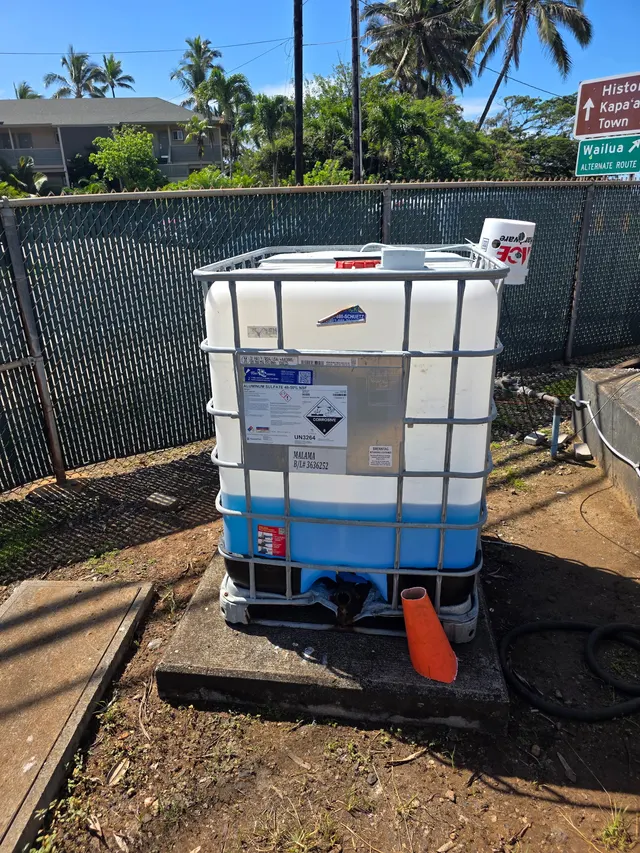
One of our dosing totes in Kapa'a, Hawaii: an IBC tote with the level sensor mounted on the lid.
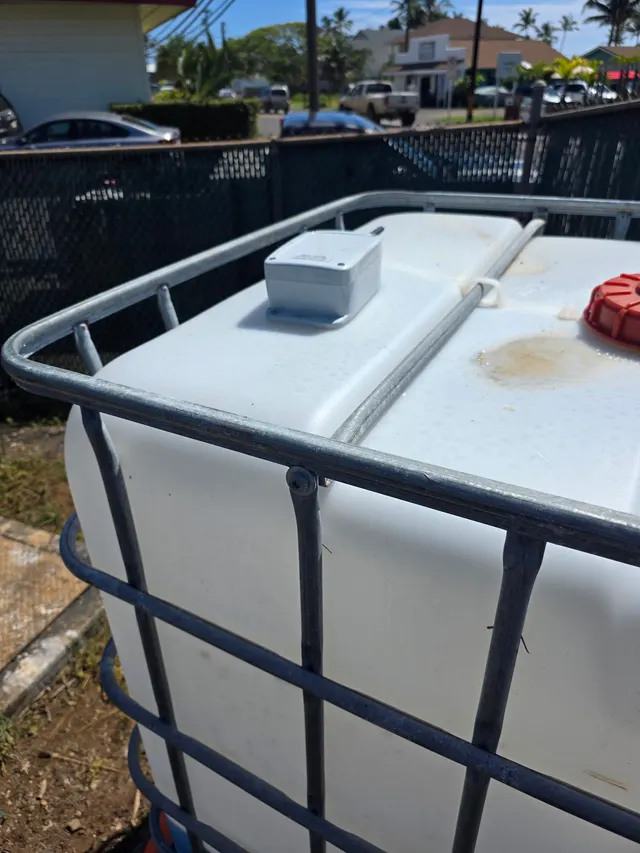
The sensor on the tote lid reads the level from above. Nothing touches the product and the tote stays sealed.
Why anaerobic water makes gas and sludge
Wastewater uses up its dissolved oxygen fast. In a force main, a wet well or the bottom of a lagoon there is none left, and the bacteria living there have to get oxygen somewhere. They take it from sulfate, which is in every wastewater stream. What is left behind is sulfide, and sulfide becomes hydrogen sulfide gas: the rotten-egg smell at the lift station, the acid that eats the crown of the pipe and the wet well walls, and the gas that kills people who open a sewer main without a monitor. The same lack of oxygen is why grease caps the flow and solids settle into sludge instead of being digested. Anaerobic bacteria work, but slowly. Aeration helps at the plant, and only there: water can hold only a small amount of dissolved oxygen no matter how hard you blow air through it, and the blowers never reach the pipes upstream.
What the accelerator does
The accelerator carries oxygen on the molecule itself, so it is available wherever the water goes, in anaerobic zones as well as aerated ones. When the native bacteria find that oxygen they use it first. The sulfate pathway is never triggered, so the sulfide that becomes hydrogen sulfide is not made in the first place. That is the difference between us and an iron salt, a scrubber or a masking agent: they deal with the gas after it has formed, we keep it from forming. The same oxygen lets the aerobic bacteria, the fast ones, multiply and work through fats, oils, grease and settled organic solids. We add no bacteria and no enzymes. The workforce is already in your water. We feed it.
As far upstream as we can reach
The best place to dose is the earliest point in the flow where we can get to water and power: a lift station, a headworks channel, a wash-down line. From there the accelerator travels with the wastewater, and the sewer lines and force mains stop being pipes that only move waste and become the first stage of biological treatment. We call that the AerobicShift, and it has its own page. For a lagoon or a series of ponds we dose the water directly and let the natural flow carry it through. Either way the goal is the same: the biology gets ahead of the load before the sludge blanket, the odor and the corrosion get ahead of you.
How we run the program
You do not buy a drum and guess. We review your current wastewater data, work out the flow rate and the volume of solids you are dealing with, and calculate a dose and frequency for your system. We survey the site and pick the delivery point. The product arrives dry; we mix and activate it in a tank on site and it drips into the flow continuously. We monitor the tank remotely and come back to replenish it every four to eight weeks depending on its size. There is no capital purchase and nothing for your operators to learn. You pay monthly, for as long as you want the result. Water quality testing runs alongside so the change shows up in your own numbers. In our field work, reductions typically start to show within six to eight weeks, and the native bacteria population grows by as much as thirty to forty times once it has the oxygen. DRP Accelerator is made by DRP Seven, and we are its exclusive distributor for the United States.
What to expect in the first weeks
In a system that has carried years of deposits, things can look worse before they look better. As the bacteria get to work, grease lifts off pipe walls and travels to the plant, suspended solids rise for a while, and the odor can spike before it falls. We tell you this before the first dose because it is the system cleaning itself, and stopping in the middle leaves the deposits where they were. Then the readings settle, cleaner than the baseline. We measure through the whole period so you can see the curve rather than guess at it.
Where it works, and where it does not
This is biology, so we are straight about its edges. The program is built for organic material: grease, manure, biosolids, the sludge a biological system produces when it falls behind. It does not dissolve sand or grit, and it cannot fix a failed aerator, a worn pump or a lagoon that is simply too small for its load. Results are site-specific, which is why we measure against your own baseline instead of quoting someone else's. Where the load is organic the same program applies across municipal collection systems, treatment plants and lagoons, farm animal waste lagoons and solids, wash-down slurries and home septic systems. If the review tells us your problem is not biological, we will tell you that too.
COMMON QUESTIONS
Straight answers.
How does DRP Accelerator work?+
It carries oxygen in a form the bacteria already in your wastewater can use, in anaerobic and aerobic conditions. With that oxygen available the bacteria stop taking it from sulfate, so hydrogen sulfide is not formed, and the aerobic bacteria multiply and digest grease and organic solids faster. We add no bacteria, no enzymes and no chemical additives.
Is it a bacteria or enzyme product?+
No. Every wastewater system already holds the bacteria it needs. Additives that pour in more cultures or enzymes are working around the real shortage, which is oxygen. We supply the oxygen and let your native population do the work.
Why not just add more aeration?+
Aeration only works where the blowers are, and water can dissolve only a small amount of oxygen however hard you push air through it. The accelerator carries oxygen on the molecule, so it reaches the force mains, wet wells and sludge blankets that aeration never touches. At the plant it works alongside your aeration, not instead of it.
Does it work in an anaerobic lagoon?+
Yes. Anaerobic zones are where it makes the biggest difference, because that is where oxygen is missing and sulfide is being made. We dose the lagoon directly or upstream of it and let the flow carry the oxygen through.
What happens in the first few weeks?+
The system cleans itself, and it can show. Grease moves, suspended solids rise for a while and odor can spike before it drops. We set the baseline before the first dose and keep measuring so you can see it settle rather than wonder.
What does it take to start a system review?+
Your system type, approximate flow or volume, the problem you want gone, and any recent test results or sludge depth readings. Estimates are fine. Send what you have and we will tell you what a review would look like for your site.
What do the two animations on this page show?+
The first is a side view of a sewer pipe. With no oxygen in the water the bacteria take it from sulfate and hydrogen sulfide bubbles up into the headspace; when the accelerator carries usable oxygen in, the same bacteria take that instead, no sulfide is made, the grease cap breaks up and the sludge layer thins as they digest it. The second is the program itself: a tote at the lift station dripping through a metering pump into the wet well, the pump cycling on its float switches, the dosed flow moving down the force main to the plant, and the tote level read by a sensor on the lid so it is refilled on a reading. Both are illustrations of the mechanism and the service, not measurements from a customer site.