Published September 24, 2026
The system
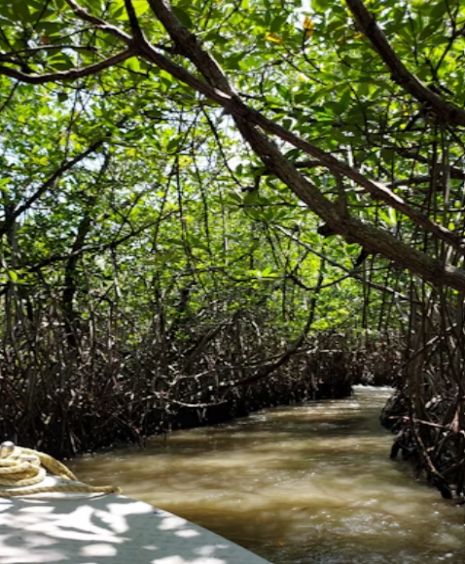
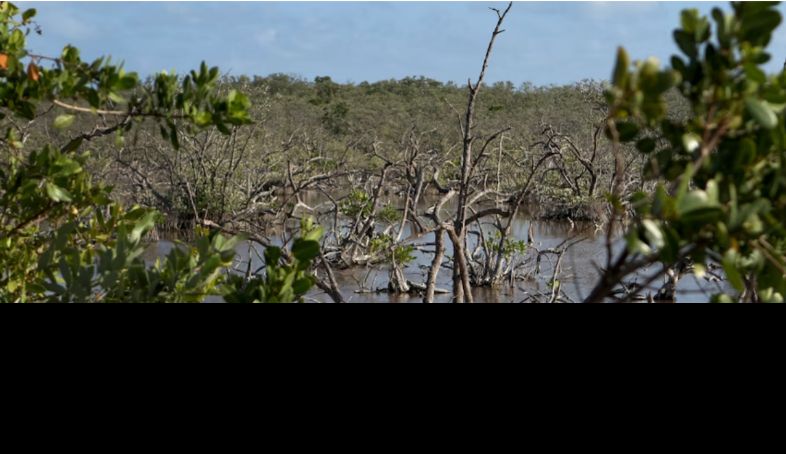
This case comes from a Venezuelan scientific research institute’s socio-environmental study of a mangrove gulf on Venezuela’s Caribbean coast damaged by hydrocarbon spills. The study tracked conditions across four sampling stations in the affected mangrove area, and the accelerator trial was run as one bioremediation option under evaluation, alongside the study’s broader work diagnosing the damage and planning a sanitation approach for the gulf. DRP Accelerator is an inorganic compound that carries usable oxygen to the bacteria already living in the soil; it is consumed as the bacteria use it and leaves nothing behind, no chemical additives. For hydrocarbon work we apply the hydrocarbon cleanup formulation of DRP Accelerator, which pairs the oxygen carrier with a bacteria package, the one place in our program where organisms are added.
The problem
Hydrocarbon spills had damaged sections of the mangrove, and the oil had settled into the subsoil rather than staying on the surface, at least five to six inches down in the treated area. That depth is what defeats most bioremediation methods built around surface contact. Reaching the affected plots was its own obstacle: the mangrove’s dense vegetation and soft terrain made every sampling and treatment trip labor-intensive, and application sections first had to be prepared by hand. Before any treatment, the study measured a hydrocarbon index of 1.24 (standard deviation 0.14) in the area later treated, and the report separately records the beginning oil level in the trial area at over 12,000 ppm.
What we did
Crews cleared and marked application sections measuring 10 by 10 meters, about 1,080 square feet, through dense mangrove. Soil samples were taken for hydrocarbon content before treatment began. Over a five-week period the accelerator was applied once a week at a concentrate dose of 1.85 grams per liter, diluted with water on site, enough to last the seven days between applications; the study describes this as a deliberately strong dose chosen for faster results, an estimated average of about 132 ppm per day. During application the soil was also mixed to work the treatment below the surface; the study protocol called for mixing because it was written to allow comparison with products that need mixing to perform. DRP Accelerator does not require it: the product is a light liquid that percolates through soil on its own. After the fifth weekly application, the field was left undisturbed for 32 more days to let the treatment continue working before final soil samples were taken.
How it was measured
The study compared soil samples taken before treatment against samples taken after the fifth application and the 32-day rest period, using a hydrocarbon index as its primary measure. The report does not state the units behind that index. It separately reports oil content in parts per million (ppm) for the same trial area, taken with the same before-and-after structure.
Results
| Measure | Before treatment | After treatment | Change |
|---|---|---|---|
| Hydrocarbon index | 1.24 (std. dev. 0.14) | 0.26 | 79.03 percent removed |
| Oil concentration | Over 12,000 ppm | 2,600 ppm | Reduced by more than three-quarters |
| Timeframe | First application to final sampling | 67 days total | 5 weekly treatments plus 32 days of rest |
The report notes that areas that started with more oil showed a higher percentage of removal. It also states that hydrocarbons in this mangrove setting accumulate mostly in the subsoil rather than the surface, which the report treats as the main reason traditional bioremediation struggles here.
The report also extrapolates the trial’s economics. Product for this trial cost under $50 to treat over 1,000 square feet. The report estimates $50,000 to $100,000 to excavate the contaminated soil and rebuild the mangrove ground physically, on top of still needing to clean the removed soil elsewhere, and puts the accelerator’s cost to treat an acre of contaminated mangrove soil at roughly $2,500 to $3,500.
| Cost comparison | Report’s figure |
|---|---|
| Product cost, this trial (over 1,000 sq ft) | Under $50 |
| Estimated cost to excavate and rebuild an equivalent area | $50,000 to $100,000 (the report’s estimate) |
| Product cost to treat one acre | Roughly $2,500 to $3,500 |
| Savings vs. physical removal, per acre | The report extrapolates more than $2 million saved per acre |
The $2 million figure is the report’s extrapolation from the trial’s small-area economics, not a measured result from a full acre.
Limitations
This is one trial from a preliminary results report, not a completed study, and it covers a single treatment cycle. Results from the study’s plots are summarized into one aggregate table rather than reported station by station, so this page cannot show how each of the four sampling stations performed on its own. The report does not state the units behind its hydrocarbon index, only the before-and-after values and the percentage change. No untreated control plot is reported alongside the treated area, so the 79.03 percent figure reflects this one treated trial, not a treated-versus-untreated comparison. The $50,000 to $100,000 excavation estimate, the per-acre product cost, and the $2 million extrapolation are all the report’s own figures, not independently audited costs. For a future customer, a result like this is a goal we measure, not a promise.
Proof assets
- The study document, a preliminary results report from a Venezuelan scientific research institute’s socio-environmental study of a mangrove gulf on Venezuela’s Caribbean coast, covering the mangrove component and the accelerator bioremediation trial referenced in this case.
- Permission to name the study partner is being confirmed; this page will be updated if it is granted.