Published September 24, 2026
The system
This case comes from a dairy in north central Texas milking about 1,000 head of cattle, a modern, well-maintained facility. Waste from the cattle pens and the milking barn is collected in a lagoon, and the lagoon water is used to irrigate a field where feed crops are grown. After harvest, as much water and sludge as possible is pumped through a sprinkler head onto that acreage to fertilize it. The study document does not name the dairy, the county or any person connected to it, and it does not give the lagoon’s total volume or its usual dredging cycle. Waste Water Innovations is confirming the dairy’s written permission before naming it on this page.
The problem
Waste from about a thousand head of cattle, kept in a contained area, runs off into the lagoon, and lagoons like this build up solids fast enough that they routinely need dredging. Lagoons run anaerobic by default: without enough dissolved oxygen for aerobic bacterial action, the anaerobic bacteria that dominate are slower at breaking down organic solids, and they produce hydrogen sulfide (H2S) and other foul smelling sulfide compounds. Pumping pressurized air into a lagoon can push it toward aerobic conditions, but the oxygen it delivers tops out at a level the bacteria cannot fully use. By the time we were called in, this lagoon’s solids had built up to the point that dredging was the option on the table.
What we did
We added DRP Accelerator, an inorganic compound that carries usable oxygen to the bacteria already living in the lagoon. We add no bacteria, no enzymes and no chemical additives. With that oxygen available, the bacteria stop taking it from sulfate, so the sulfide compounds behind the odor are not formed, and aerobic bacteria go to work on the fats, oils and grease (FOG) and organic sludge in the lagoon. The accelerator is consumed as the bacteria use its oxygen; nothing of it is left downstream. We started with one 55-gallon drum added to the lagoon, then repeated the addition three more times over the following eight weeks, four drums and 220 gallons total. A stirring mechanism ran only while a drum was being added, not continuously. For the same mechanism applied more broadly to lagoon solids, see manure and sludge reduction.
How it was measured
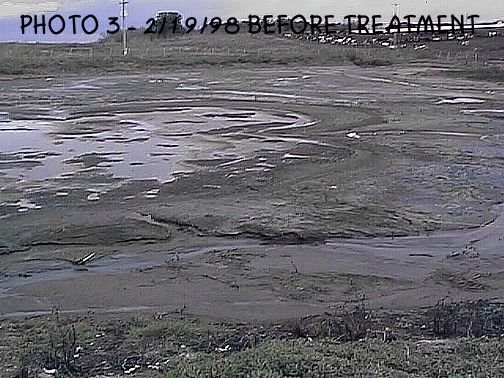
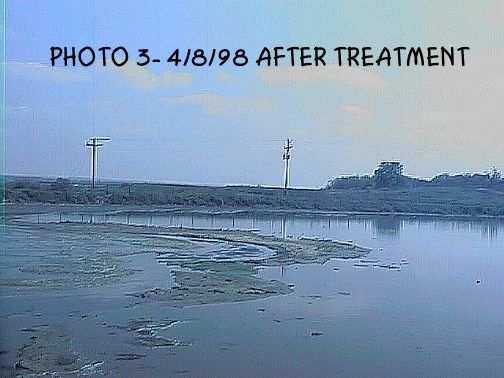
This is photographic and operational evidence, not a lab series. The study document includes a set of before-and-after photographs of the lagoon, the stirring mechanism and the sprinkler head, taken about forty days apart, and a written account of the pumping run that followed. No sludge depth survey was taken before or after treatment, so this case cannot report a percentage reduction in solids, only what the photographs and the pumping record show. The photographs were taken about forty days apart; the twelve-day pumping account that follows is not separately dated in the document, so we cannot confirm exactly how long after those photographs the sprinkler ran. The document does not name who took the photographs or ran the pump.
Results
After the fourth drum went in, the lagoon was pumped through a 2-inch line to a 1-inch sprinkler head onto the field. The year before this treatment, that same sprinkler head had plugged after a single day of pumping; this time, the dairy operator would have considered five days of pumping a success. The pump ran for twelve days straight, eight to twelve hours a day, and never shut down for plugging; no cleaning was required. By the second day of pumping the free water on the surface was gone, and the ridge of solids visible in the before photographs was breaking apart as water from the far side of the lagoon cut through it; the pump kept moving solids for days after that without plugging, because the sludge itself had thinned enough to pump. The lagoon was eventually pumped several feet lower across its whole surface than any of the photographs show, and pumping could have continued past twelve days, since no plugging had occurred. No odor was found standing in the field near the active sprinkler head.
| Measure | Year before treatment | After DRP Accelerator treatment |
|---|---|---|
| Days pumped before plugging | 1 day | 12 days, no plugging |
| Daily pumping hours | Not recorded | 8 to 12 hours a day |
| Cleaning required | Not recorded | None |
| Odor at the sprinkler head | Not recorded | None detected |
| Treatment detail | Record |
|---|---|
| Dose | Four 55-gallon drums of DRP Accelerator, 220 gallons total |
| Schedule | Added over eight weeks |
| Mixing | Stirring mechanism run only during each addition |
| Estimated savings | The report estimates more than $500,000, in 2025 dollars |
For a dairy case where we also have lab-measured results, see the central Utah dairy case study.
Limitations
This is photographic and operational evidence, not a lab series, and there is no sludge depth survey behind it, so this case reports what was pumped and photographed rather than a measured percentage of solids removed. The photographs were taken about forty days apart; the twelve-day pumping account is not separately dated in the document, so we cannot say exactly how much time passed between the photographs and that pumping run, or confirm the calendar year of the work from the narrative text alone. There is no untreated comparison lagoon: the comparison is the same sprinkler line, one year apart. The document does not give the lagoon’s total volume, its normal dredging cycle, or who operated the pump or took the readings. The savings figure is the report’s own estimate, not an independent appraisal. For a future customer, a result like this is a goal we measure, not a promise.
Proof assets
- The study document, “Dairy Lagoon Case History,” with its before-and-after photographs of the lagoon, the stirring mechanism and the sprinkler head.
- The two photographs above, from that document.
- Waste Water Innovations is confirming the dairy’s written permission before naming it on this page.