Published September 9, 2026 · Updated September 24, 2026
The system
The lagoon serves a goat dairy and research herd at a Texas university. Waste from the barns, routine hose-downs, and research work done in the barns all drained into the lagoon system, along with runoff carried through drainage sluices and gutters. Two lift stations, one on each side of the property, connected through a 600-foot, 18-inch line that moved flow between them. We describe the facility by type and state; Waste Water Innovations is confirming its written permission before naming it on this page.
The problem
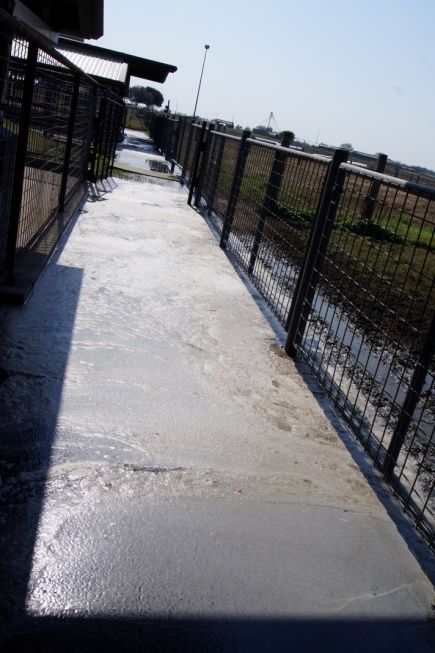
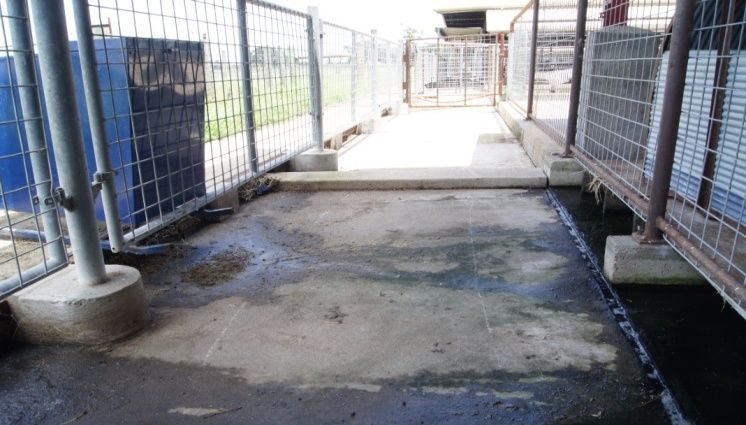
The lagoon had not been dredged, serviced, or pumped in over ten years, apart from one brief partial dredge in the previous seventeen years. Settled goat manure had hardened enough that a sample rod could barely break through the crust. Both lift stations were full of solids, and the 600-foot, 18-inch line connecting them was completely plugged: no fluid moved between them at all. Every concrete drainage gutter on the property held standing solids, and the grass around the west side of the lagoon stayed under dirty standing water. The backup was bad enough that the dairy lost its license to sell the cheese made on site; the milk went to pig feed instead. The university’s quote to dredge the lagoon alone ran more than $250,000, and that quote did not include cleaning the two lift stations, clearing the plugged line, or restoring the surrounding fields. Lagoons that go years without service like this one are common in agricultural operations carrying heavy manure loads.
What we did
We dosed DRP Accelerator onto the lagoon surface, starting at ten gallons a day sprayed across the water, and added it on a regular schedule to the two lift stations. Within days the solids began to gas off as bacterial activity picked up, and a floating island of solids rose to the surface; it sank again a few days later as the trapped gas escaped. DRP Accelerator is an inorganic compound: it carries usable oxygen to the bacteria already living in the lagoon and the lift stations. We add no bacteria and no enzymes and no chemical additives; the bacteria already on site did the work once they had oxygen to use. As the line and the lift stations cleared, the system began moving flow by gravity instead of standing full. The lagoon sits next to an irrigation lagoon, separated by a berm and connected through a 24-inch equalizer pipe; as the goat lagoon side cleared, the irrigation lagoon improved as well, and its own sludge became pumpable again. We pumped the goat lagoon down using a two-inch trash pump and rented three-inch trash pumps, running more than 500 feet of discharge hose.
How it was measured
The university’s microbiology department sampled the treated lagoon sludge through the project and sent it to its own lab. That sampling identified twenty-seven bacteria species in the sludge, and the department’s own conclusion, as the report states it, was that the treatment performed better than advertised. The volume pumped, an estimated 450,000 gallons, comes from the report’s account of the pump-out itself; there was no metered flow record and no sludge-depth survey before or after treatment. The report does not name who supervised the sampling or give exact dates. For more on why bacteria need oxygen to do this work, see our explanation of the aerobic shift.
Results
| Measure | Before treatment | After treatment |
|---|---|---|
| Lagoon sludge | Thick, hardened solids coating the surface, hard to sample | Thinned to a pumpable consistency; an estimated 450,000 gallons removed by trash pump |
| Two lift stations | Full of solids | Clean, moving flow by gravity |
| 600-foot, 18-inch connecting line | Completely plugged, no flow | Flowing within a week, fully open in under two weeks |
| Drainage gutters and pastures | Held standing, dirty water | Clean, no standing water |
| Dairy license to sell cheese | Lost due to the backup | Regained after inspection passed |
The university’s dredging quote for the lagoon alone was more than $250,000, and it excluded the lift stations, the connecting pipe, and the fields. The report states the full program, equipment and labor included, was priced at $30,000. The organic material pumped from the lagoon was used as fertilizer on several fields as part of an urban farming project, and the report says the grass on those fields grew three to four times taller than surrounding fields in a short time. Turtles, small fish, tadpoles, and the birds that visit the lagoons were unaffected by the treatment; the report notes the turtle population appeared to improve. For a similar pump-out at a dairy lagoon, see our twelve-day pumping case study.
Limitations
This is one field report, not a monitored trial. The 450,000-gallon figure is the report’s own estimate of what came out during the pump-out, not a metered reading, and an earlier summary of this project gave a lower figure of 350,000 gallons; this case study uses the fuller report’s number. There is no sludge-depth survey from before treatment to compare against, and no untreated control. The dose schedule beyond the initial ten gallons a day sprayed on the lagoon surface, and the exact schedule of lift station dosing, are not detailed in the report. The bacteria species count and the performed-better-than-advertised finding are the university’s own laboratory conclusions, as the report describes them; we did not independently review the lab’s underlying data. For a future customer, a result like this is a goal we measure, not a promise.
Proof assets
- Our project summary report for this goat lagoon treatment, with a before-and-after description of the lagoon, the two lift stations, the connecting line, the pastures, and the irrigation lagoon next door.
- Photos of the drainage sluice at the lift stations before and after treatment, included above.
- Waste Water Innovations is confirming the facility’s written permission to publish its name.